


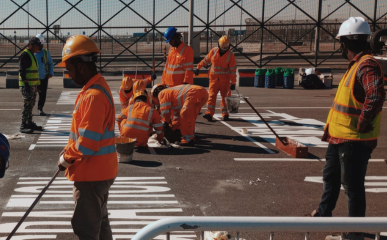
 Road marking service in india
Let’s Start With an Uncomfortable Truth
India loses over 1.5 lakh lives to road accidents every year. That number is staggering. But what makes it even harder to sit with is that a significant chunk of those deaths are tied to something completely preventable — poor, faded, or simply missing road markings.
Think about it. An unmarked pedestrian crossing on a busy arterial road. A highway lane boundary that has worn away after one monsoon. An industrial yard where vehicles and workers share space with zero visual guidance. These are not fringe scenarios. They happen everywhere, every day.
If you are a civil engineer, a facility manager, an HSE officer, or a procurement head, you already know that road markings are not a cosmetic afterthought. They are a legal obligation, a safety commitment, and — when done wrong — a significant liability. The problem is, most B2B buyers in India go into the contractor selection process without a clear framework. They get three quotes, pick the cheapest one, and hope for the best.
That approach has consequences. Markings that fade in six months. Site inspections that fail. Tenders that get flagged. And in the worst cases, accidents that end up in court.
This guide is for people who want to do it properly. Whether you are managing a national highway project, a warehouse campus, a smart city rollout, or a multi-storey parking facility — the framework here will help you evaluate, compare, and hire road marking contractors in India with real confidence.
1. Why This Decision Carries More Weight Than You Think
Here is something worth understanding early: choosing the wrong road marking contractor is not just an operational headache. It is a financial risk, a compliance risk, and depending on the project, a legal one.
What Actually Goes Wrong When You Pick the Wrong Contractor
Most procurement decisions that go badly share one thing in common — the problems do not show up immediately. The markings look fine on day one. The issues surface three months later, once the contractor has been paid and moved on.
- Substandard thermoplastic or paint materials that fade within 3 to 6 months, forcing costly rework
- IRC (Indian Roads Congress) non-compliance that causes failed quality audits — sometimes mid-project
- Legal exposure when accidents occur on roads or sites where markings have deteriorated
- Project delays because the crew was under-equipped or the site execution was disorganised
- Failed inspections by PWD, NHAI, or municipal bodies, which trigger penalties and damage your standing on future tenders
For reference: thermoplastic markings applied correctly using IRC-compliant materials should hold up for 3 to 5 years under normal traffic conditions. A substandard paint job on the same stretch? You might not make it through a single monsoon season.
What Each Stakeholder Actually Stands to Lose
The stakes look different depending on your role — but they are real across the board for road marking services B2B India buyers.
- Facility Managers carry personal accountability for safety compliance. If a visitor trips or a vehicle collides because markings were invisible, the liability lands on your desk.
- Procurement Managers are judged on value delivered, not just money saved. When rework is required, you own that explanation to senior leadership.
- Government Procurement Officers face tender audit scrutiny. Substandard contractor selection can trigger departmental inquiries.
- Site Engineers cannot sign off quality approvals if markings fail inspection criteria. That bottleneck holds up the entire project.
- HSE Officers are responsible for workplace safety compliance across industrial sites. Inadequate markings put you in direct conflict with regulatory obligations.
Getting this decision right protects everyone. So let us get into exactly how to do that.
2. What to Actually Look for When Evaluating a Road Marking Contractor
Beyond the brochure and the sales pitch, there are four things you need to assess. Skip any of them and you are taking a gamble.
Licensing, Certifications, and Compliance — The First Filter
Before anything else, compliance. A credible contractor operating in India should be able to hand you these documents without blinking:
- IRC compliance certification, or documented adherence to IRC:35 road marking standards
- NHAI or PWD empanelment status — non-negotiable for government-linked projects
- Valid GST registration and a current trade licence for the state they are operating in
- ISO 9001 certification, which indicates a structured quality management system
- Verifiable experience across both government and private sector road marking projects
If a contractor hesitates, deflects, or cannot produce these, remove them from your shortlist immediately. Compliance is not something you negotiate on — especially when public roads or high-traffic industrial sites are involved.
Experience and Track Record — Past Projects Tell the Real Story
Certifications tell you a contractor is eligible. Experience tells you whether they can actually do the job.
Years in business matters less than the depth and diversity of their project portfolio. Specifically, look for:
- Completed projects across different categories — highways, airports, warehouses, residential campuses, industrial zones
- Client references you can genuinely call, not just logos arranged on a capabilities deck
- Before-and-after photographs that show the quality of their finished work
- Geographic presence across your region or across India, depending on your project’s scope
Ask a direct question: have they delivered projects at a similar scale and complexity to yours? A contractor who does excellent work on parking bays may be completely out of their depth on a 50-kilometre highway marking contract. Scale matters.
Materials and Technology — This Is Where Quality Is Really Decided
The material a contractor uses is the single biggest determinant of how long your road markings last. When you hire road marking contractor India professionals, this conversation is not optional.
- Thermoplastic markings: The benchmark for high-traffic roads. Durable, retro-reflective, IRC-compliant, and typically lasting 3 to 5 years when applied correctly.
- Cold plastic markings: Faster to apply and suitable for moderate-traffic areas, though slightly less durable than thermoplastic.
- Epoxy markings: The right choice for warehouse floors and low-speed industrial zones, where adhesion to concrete or tile is the priority.
- Retro-reflective glass beads: Often overlooked, but bead quality directly determines night visibility. Poor beads mean poor retroreflectivity — full stop.
- Machine quality: Professional contractors use dedicated road marking machines. If they are quoting manual rollers for a large-scale project, walk away.
Ask every shortlisted contractor for a material data sheet (MDS) or technical specification document. This single document tells you exactly what grade and brand of material they plan to use — and whether they are willing to commit to it in writing.
Team Strength and Execution Capacity — Can They Actually Deliver?
Great materials on paper mean nothing if the site crew cannot execute. Before signing anything, get honest answers to these questions:
- How many trained crew members can they field for a project of your scale?
- What does their equipment fleet look like — how many machines, what type, what condition?
- Are they running multiple projects simultaneously? And if so, how do they manage quality across all of them?
- Will a dedicated project manager be assigned to your contract, or will you be chasing updates from a shared line?
A contractor with two marking machines trying to complete a 10-kilometre highway job in 10 days is not going to give you a good outcome. They will either rush it or delay it. Capacity alignment is not a minor detail — it is a fundamental part of the evaluation.
3. Reading a Road Marking Quotation — What to Look for and What to Avoid
Quotations are where a lot of procurement decisions quietly fall apart. Road marking services quotation India documents vary wildly in quality and detail — and that variation tells you a great deal about the contractor before a single line is painted.
What a Proper Quotation Should Always Include
A quotation from a serious contractor should be detailed enough that you could hand it to someone unfamiliar with the project and they would understand exactly what is being proposed. At minimum, it should contain:
- A clearly defined scope of work: total area in square metres, total length in linear metres, types and number of symbols or markings
- Material specifications: brand name, grade, application thickness (3mm is standard for thermoplastic), bead application rate
- Labour charges separated from material costs — so you can see where the money actually goes
- Mobilisation and demobilisation costs for equipment and crew transport
- A warranty period stated explicitly and in writing — not verbally promised
- Full GST breakdown (18% applies to most road marking services)
- Payment terms tied to project milestones, not arbitrary dates
If anything on that list is missing, ask for a revised quotation. A contractor who pushes back on providing itemised detail is usually a contractor hiding something.
Red Flags That Should Immediately Raise Questions
These are the warning signs that show up repeatedly in road marking company price list India documents that later cause problems:
- Lump sum pricing with no breakdown — you cannot audit what you are paying for
- No mention of material brand or grade — a classic move when substituting cheaper materials
- A price significantly below market rates — low-grade materials and shortcuts always have to come from somewhere
- No warranty clause — any contractor who stands behind their work will commit to this without hesitation
- Vague project timelines or no schedule at all — a strong predictor of delays once work begins
Comparing Contractors Side by Side
Never compare quotations on headline cost alone. Build a comparison matrix and evaluate each contractor across multiple criteria simultaneously. Here is what a useful comparison looks like:
| Pro tip: Before signing a full contract, ask your top two candidates to complete a small trial patch on a low-visibility section of the project. Real-world workmanship tells you far more than any document. |
4. Navigating Road Marking Contract Tenders in India
For government procurement officers and public sector project teams, the tendering process is its own challenge. Understanding how road marking contract tender India procurement works is what separates well-run tenders from ones that drag on, attract underqualified bidders, and deliver poor outcomes.
The Main Types of Road Marking Tenders
Procurement routes in India generally fall into one of these categories:
- Open Tenders (NIT): Published publicly on government portals — any eligible contractor can submit a bid.
- Limited Tenders: Restricted to contractors already empanelled with NHAI, PWD, or a relevant state authority.
- GeM (Government e-Marketplace): The central procurement platform for government departments. Its use for road marking services has grown significantly in recent years.
- BOQ-based Contracts: Contractors price against a pre-defined Bill of Quantities — the most transparent format for comparison.
- Rate Contracts: A fixed rate is agreed for a defined period and work orders are issued as needed.
Smart City Mission and AMRUT projects typically go through state-level designated agencies and carry their own technical qualification criteria. Know which route applies to your project before you design the tender structure.
What to Require in a Tender Submission
When evaluating bids received through a road marking contract tender India process, the technical qualification package from each contractor should include:
- Company registration certificate and memorandum of association
- Previous work experience certificates that specify project value, location, and year of completion
- Audited financial turnover for the last three financial years
- Equipment ownership or lease documentation — marking machines, compressors, traffic management vehicles
- CVs for key personnel, particularly project managers and quality control officers
- EMD (Earnest Money Deposit) and bid security as specified in the tender notice
How Government Tenders Actually Evaluate Contractors
Most government road marking tenders use a two-stage process, and it is worth understanding how this works before you structure your evaluation criteria:
- Stage 1 — Technical Qualification: Verify experience depth, financial standing, equipment capacity, and compliance certifications. Only contractors who meet the technical threshold move forward.
- Stage 2 — Financial Bid (L1): Among technically qualified bidders, the lowest price (L1) typically wins. This is why Stage 1 rigour matters so much — it determines who is even in the room.
Additional factors — past performance ratings, local presence affecting mobilisation speed, and quality track record — carry weight in the technical scoring even if they are not always quantified explicitly.
Practical Tips for Running a Better Tender
- Attend pre-bid meetings yourself if possible — how a contractor behaves and what questions they ask tells you a great deal
- Open and evaluate technical bids fully before you even look at financial bids — do not let price contaminate your technical assessment
- Cross-verify empanelment status directly with NHAI or PWD — self-declarations alone are not sufficient
- Run reference checks with at least two of the government clients listed in each contractor’s experience certificates
A well-structured tender process protects public funds and produces better infrastructure. Cutting corners in technical evaluation to save time almost always costs more in the end.
5. Managing the Contract Once Work Begins
Selecting the right contractor gets you to the starting line. Managing the contract well is what actually gets you to a good outcome. This part gets skipped too often.
Lock Down Scope and Quality Standards Before Anyone Arrives on Site
Before a single machine shows up, these things need to be agreed, documented, and signed off by both parties:
- Area coverage broken down by zone, with line width specifications and IRC-compliant colour codes
- Measurable quality benchmarks: minimum retroreflectivity values, thickness tolerances, adhesion requirements — not vague descriptors like ‘good quality’
- Inspection milestones tied to project phases, with the explicit understanding that payment is conditional on passing quality checks
- A formal work order that references the agreed quotation, material specifications, delivery timeline, and warranty terms
Verbal agreements fall apart in disputes. Document everything, even the conversations that seem obvious.
Quality Checks During Execution — Do Not Wait Until It Is Done
Implementing quality monitoring throughout execution — not just at the end — is what separates projects that succeed from those that require expensive rework.
- Retroreflectivity testing of completed markings using a retroreflectometer — especially important for highway projects where night visibility is safety-critical
- Thickness measurement of thermoplastic markings using a wet film gauge during application, before the material sets
- Adhesion and durability spot checks at random intervals across different sections of the project area
- Night visibility inspections, ideally at multiple points during execution
- Photographic documentation at each stage, geo-tagged where possible — this becomes your audit trail if any disputes arise later
Assign a dedicated quality officer from your team to be present during critical execution phases. That one decision prevents the majority of quality disputes that surface post-completion. It is not about distrust — it is about accountability.
Warranty, Long-Term Maintenance, and Building the Right Vendor Relationships
The project does not end at sign-off. Plan for what comes next.
- Negotiate a minimum 12 to 24-month warranty on thermoplastic markings in writing, as part of the contract — not as a verbal afterthought
- For high-traffic zones — highways, busy industrial yards, large parking facilities — consider an Annual Maintenance Contract (AMC) for periodic inspections and touch-ups
- Build and maintain a preferred vendor list so you are not starting the evaluation process from scratch every time you have a new project
- Conduct a formal post-project performance review for each contractor — that documented record becomes your most valuable reference when shortlisting for future work
The best road marking contractors actually welcome the warranty conversation. They know their work holds up, so they do not flinch at committing to it. A contractor who hedges on warranty terms is telling you exactly what they think of their own quality.
Frequently Asked Questions
Q1: How much does road marking typically cost in India?
It varies — and the range is wider than most people expect. Thermoplastic road marking generally runs from ₹40 to ₹120 per linear metre, depending on line width, material grade, and bead application rate. Epoxy markings for industrial floors are often priced by square metre rather than linear metre. The most important thing: always request an itemised road marking company price list India document from each contractor you are comparing. A lump sum quote with no breakdown makes genuine comparison impossible and gives you no protection if disputes arise.
Q2: How do I verify whether a contractor is genuinely NHAI or PWD approved?
Ask for the empanelment certificates directly — and then cross-verify. NHAI maintains approved contractor information on its official portal. State-level PWD empanelment lists can be requested from the respective state PWD office. Do not rely solely on what a contractor tells you or shows you. Genuine approved contractors will also have project completion certificates issued by these government bodies — not just testimonial letters from private sector clients.
Q3: How long does a typical road marking project take?
Scope and scale determine this more than anything else. Small projects — parking areas, internal campus roads, warehouse floors — are often done in one to three days. Medium projects covering industrial estates or institutional campuses typically take one to two weeks. Large highway projects or multi-kilometre Smart City contracts can run anywhere from two to six weeks, factoring in traffic management requirements, weather windows, and crew availability. Whatever the estimate, get a detailed project schedule before work begins — not a rough verbal timeline.
Q4: Can government buyers actually use GeM for road marking procurement?
Yes, and increasingly they do. The Government e-Marketplace lists empanelled road marking service providers across India. For government procurement officers and PSU purchase managers, GeM allows you to raise road marking contract tenders directly on the platform with a faster and more transparent procurement cycle. An added advantage: GeM-listed contractors have already passed a basic compliance verification, which reduces the screening burden on your side. For non-government buyers, GeM is also a useful benchmarking reference for market rates and contractor credentials.
Q5: What warranty terms should I realistically expect?
For thermoplastic markings under normal traffic conditions, a professional contractor should offer a minimum 12-month warranty. Stronger contractors — the ones who know their materials and application process are solid — routinely commit to 18 to 24 months. Paint-based markings carry shorter warranties, typically three to six months, reflecting their lower durability. Always get the warranty in writing as part of the contract, with clear definitions: what qualifies as a defect (fading below a specified retroreflectivity threshold, peeling, cracking), and what the contractor’s obligation is when defects occur. A verbal promise is not a warranty.
Choosing the right road marking contractor in India is not complicated — but it does require discipline. It means resisting the pull of the lowest quote. It means checking documents, not just taking things at face value. It means managing the contract actively, not just awarding it and walking away.
The contractors worth hiring make this process easy. They have their certifications ready, their material data sheets detailed, their warranties committed to in writing. They show up to pre-bid meetings knowing the questions to ask. They do not resist quality monitoring on site.
The ones worth avoiding — they reveal themselves early too. Vague quotations. Missing compliance documents. Pressure to decide quickly before you have done your checks.
Use the framework in this guide consistently. Document every step. Build long-term relationships with contractors who have actually proven their work holds up over time. Road markings are infrastructure — and infrastructure deserves to be done properly.
| Get a Free Road Marking Services Quotation from Our Experts Today |
| Have a project in mind? Talk to our road marking specialists — no obligation. |
